


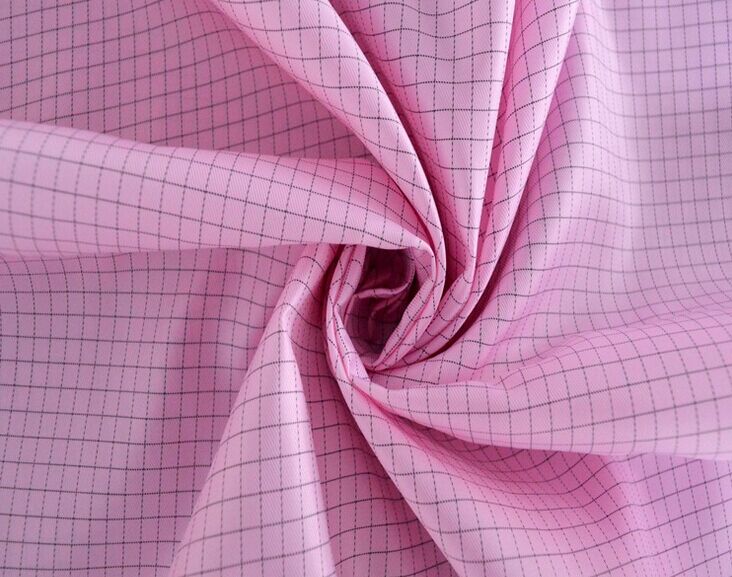
grille sergé anti-statique tissu de taffetas, ESD Tissu
Anti-Static Twill Grid Taffeta Fabric (ESD Tissu, Item F820) est un poids léger, convivial pour la production static-control textile engineered for B2B uniform and protective workwear programs in laboratoires, installations électriques, and oil/chemical industry environments. It combines a durable 2/3 twill structure avec un 0.5grille conductrice cm using 98% polyester + 2% fil conducteur de carbone, and is specified at 110 gsm with a resistance range of 10⁶–10⁸ Ω—ideal for consistent bulk sourcing and repeat orders.
Enquête- Description
Anti-Static Twill Grid Taffeta Fabric (ESD Tissu) – F820
In professional manufacturing and lab environments, static electricity is not only a comfort issue—it can become a risque qualité (damage to static-sensitive items), un risque de processus (particle attraction and contamination concerns), and in some facilities a safety concern depending on the materials and atmosphere involved. That’s why premium B2B buyers don’t purchase “anti-static fabric” as a generic lining—they purchase it as part of a documented Programme de contrôle ESD that includes materials, habits, mise à la terre, entraînement, et vérification.
F820 Anti-Static Twill Grid Taffeta is designed to fit that program-style sourcing approach: it gives procurement teams a clear spec sheet (composition, motif conducteur, resistance range, poids, largeur, MOQ), while providing garment factories with a stable woven structure that cuts and sews efficiently at scale.
Spécifications clés
These are the core RFQ fields directly shown on the referenced product page:
| Article | Spécification |
|---|---|
| Nom de l'article | grille sergé anti-statique tissu de taffetas, ESD Tissu |
| Aucun article. | F820 |
| Matériel | 98% polyester / 2% carbone |
| Nombre de fils | 75D x 75D |
| Poids | 110 gsm |
| Densité | 188 × 120 |
| Largeur | 148 cm |
| Style / Tisser | 2/3 Sergé |
| espace Conductive | 0.5 cm conductive grid |
| La résistance | 10⁶–10⁸ (Ω comme indiqué) |
| MOQ | 1000 mètres |
| Paiement | TT, L / C, Western union |
| Utilisation typique | Workwear for laboratory, Puissance, oil/chemical industry |
What Makes F820 an “ESD / Tissu antistatique?
1) Carbon conductive yarn creates a controlled discharge pathway
F820 uses 2% carbone in the construction to provide conductive pathways that help reduce static build-up and allow charges to dissipate more predictably than ordinary synthetic fabrics.
2) 0.5cm conductive grid improves uniformity and QC visibility
Le 0.5grille en cm is a strong B2B feature because it’s:
-
Easy to document in tech packs and procurement specs
-
Easy to QC visually (grid consistency across lots)
-
Easy to standardize for repeat orders and multiple factories
3) Resistance range aligned with common “dissipative” expectations
Les listes de produits 10⁶–10⁸ Ω.
Many ESD references describe “dissipative” materials in the general window around 10⁶ to 10⁹ ohms (definitions and test methods vary by application).
That makes F820 a practical choice for uniform/workwear programs that need controlled static dissipation—especially when matched to the buyer’s required test method and verification plan.
Note de sécurité pour l'acheteur: resistance can vary with humidity, conception de vêtements, laundering cycles, and test setup—so premium programs typically verify finished garments, pas seulement des échantillons de tissus. IEC garment test methods explicitly cover measuring electrical resistance across garment components, coutures, and cuffs.
Why Premium B2B Buyers Choose F820
Lightweight but durable: 110 gsm for daily wear + production efficiency
À 110 gsm, F820 is light enough for comfortable shift wear and layered garment systems, yet structured enough (with twill + higher density) to perform in daily uniforms and protective workwear.
Twill structure for better drape and workwear feel
Le 2/3 sergé weave typically provides a balanced feel that works well for uniforms: bon drapé, stable handling during sewing, and a professional “workwear” appearance. (Your final handfeel can also depend on finishing and garment construction.)
Clear spec sheet for fast procurement decisions
Your buyer’s procurement team needs a quick “yes/no” based on: composition, grid spacing, resistance range, poids, largeur, MOQ. This product page provides those decision fields directly—reducing RFQ back-and-forth and improving conversion.
Industry-targeted positioning (lab, Puissance, oil/chemical)
The product is explicitly positioned for workwear in laboratory, Puissance, et industries pétrolières/chimiques—which aligns with the exact buyer segments that tend to request ESD/anti-static features during sourcing.
Applications typiques
1) Industrial workwear programs
-
Vestes ESD, pantalon, combinaisons
-
Production floor uniforms in static-managed zones
-
Maintenance uniforms where static control is part of the purchasing checklist
2) Laboratory & controlled environments
-
Lab coats and inspection coats
-
ESD smocks for controlled work areas
-
Lightweight outer layers or internal panels depending on garment design
3) Oil / chemical industry workwear systems
Where anti-static workwear is specified to reduce electrostatic risk, fabrics are usually evaluated not only by resistance targets but also by garment design and how the garment integrates into the facility’s earthed system and procedures. (If your end market requires EN 1149 PPE certification, please specify it early—see below.)
Normes & Testing Guidance
ESD performance is a “system,” not a single fabric claim
CEI 61340-5-1 describes requirements for an Programme de contrôle ESD (planning, implementation, and maintenance).
Industry guidance also emphasizes that ESD programs typically include training and compliance verification/auditing, not only materials.
Pour les marques B2B, this is important messaging: it keeps your product page credible and reduces disputes caused by over-claiming.
Finished-garment resistance testing matters
CEI 61340-4-9 provides standard test methods for caractérisation résistive du vêtement, including point-to-point and sleeve-to-sleeve methods and consideration of seams/cuffs.
If your customers require audit-level results, plan a sampling step where the finished coat/smock/coverall is tested under the required method.
If your end use is explosive-risk (ATEX-type), confirm EN 1149 itinéraire
DANS 1149 is a commonly referenced series for electrostatic properties of protective clothing; DANS 1149-5 specifies performance requirements for protective clothing that dissipates electrostatic charges as part of a total earthed system (commonly relevant in explosive-risk environments).
If your program needs EN 1149 attestation, share the exact part(s) required and any additional PPE standards needed for your market.
OEM / Options de personnalisation
For high-quality B2B brand customers, customization and program control are often what closes the order:
-
Personnalisation des couleurs (couleurs uniformes; bande d'ombrage pour les commandes répétées)
-
Grid layout confirmation (appearance consistency across garment panels)
-
Longueur du rouleau, emballage, and labeling aligned to cutting-room workflow
-
Lot tracking & QC plan for long-term supply stability
-
Testing alignment: fabric swatch checks + garment prototype testing per your customer’s method
Informations de commande
-
MOQ: 1000 mètres
-
Paiement: TT, L / C, Western union
Pour les programmes premium, la meilleure pratique est:
-
approve shade + handfeel with lab dips / samples
-
build a prototype garment and verify the required resistance method
-
lock bulk supply with lot controls (repeatability is the real “premium” value)
Appel à l'action (Demande de prix / Échantillon / Fiche technique)
Si vous recherchez Anti-Static Twill Grid Taffeta (F820) for workwear or laboratory garments, send your use case and test requirements. Nous vous répondrons par un offre détaillée, options d'échantillonnage, and a practical testing plan that matches your customer audits.
Liste de contrôle rapide pour les appels d'offres (recommandé):
-
type de vêtement (blouse de laboratoire / blouse / combinaison / veste)
-
exigence de résistance cible + test method (fabric vs garment)
-
couleur + prévision annuelle
-
lieu de livraison + préférences d'emballage
-
any required standards (CEI 61340 / DANS 1149, etc.)
FAQ
T1: What is the standard composition of F820?
98% polyester / 2% carbone conductive yarn.
T2: Que signifie « espace conducteur de 0,5 cm » ??
It refers to the spacing of the conductive grille—listed as 0.5 cm on the product page.
T3: Quelle plage de résistance est répertoriée pour ce tissu ESD?
La page produit répertorie 10⁶–10⁸ (Ω comme indiqué).
T4: Le tissu est-il suffisant à lui seul pour garantir la conformité ESD?
Généralement non. ESD control is typically managed through an Programme de contrôle ESD that includes procedures, entraînement, and compliance verification.
Q5: Do buyers need garment-level testing?
Often yes—especially for audits. IEC garment test methods cover measuring resistance across garment components including seams and cuffs.
Q6: Quels sont le poids et la largeur standard?
110 gsm et 148 cm largeur.
Q7: Quel est le tissage/style?
C'est 2/3 sergé.
Q8: What is the MOQ and payment term?
MOQ est 1000 mètres; payment options listed include TT, L / C, Western union.
Q9: Pour quelles industries est-il conçu?
The page notes use in vêtements de travail pour laboratoire, Puissance, et industries pétrolières/chimiques.
Q10: If we need EN 1149 compliance, can this fabric be used?
Potentially—but EN 1149 compliance depends on the vêtement fini, the design, and how it’s used as part of a total earthed system. Confirm the exact EN 1149 parts and your customer’s test route before finalizing sourcing.
Tissu anti-statique
ENVOYER UNE DEMANDE
Produits connexes

Copyright © 2026 Lean Textile Co., Limited Tous droits réservés