



ESD Twill Taffeta Fabric, Anti-static Fabric
This ESD Twill Taffeta fabric is a lightweight, production-friendly anti-static textile designed for B2B buyers supplying cleanroom, laboratory, and electronics-related protective garments. Built with 99% polyester + 1% carbon conductive yarn, a 0.5cm conductive spacing, and a target surface resistance of 10⁶–10⁸ Ω, it helps reduce static build-up on apparel when used correctly as part of an ESD control system. Standard construction includes 75D×100D yarn, 108 gsm, 148 cm width, and a 2/3 twill weave.
Inquiry- Description
ESD Twill Taffeta Fabric, Anti-Static Fabric (Item No. F620)
In many factories, static electricity isn’t just annoying—it can become a quality risk (damaged electronics), a process risk (particle attraction in cleanrooms), and a safety risk (incendiary discharge in certain environments). That’s why premium manufacturers don’t treat ESD clothing as a “low-cost uniform.” They treat it as part of a documented, repeatable ESD control program, where garments, grounding, training, and verification work together.
Our ESD / anti-static fabric twill (F620) is developed for that program-style sourcing: clear specs, stable bulk supply, and an ESD performance range suited to common cleanroom and lab apparel use cases—especially ESD smocks, lab coats, coveralls, jackets, and workwear for static-sensitive operations.
Key Specifications (from the product page)
-
Item Name: ESD / Anti-static Fabric Twill
-
Item No.: F620
-
Material: 99% Polyester + 1% Carbon
-
Yarn Count: 75D × 100D
-
Weave / Style: 2/3 Twill
-
Weight: 108 gsm
-
Density: 188 × 89
-
Width: 148 cm
-
Conductive Spacing: 0.5 cm
-
Resistance: 10⁶–10⁸ Ω
-
MOQ: 1000 meters
-
Payment: T/T, L/C, Western Union
What Makes This Fabric “ESD / Anti-Static” (and why it matters)
1) Carbon conductive yarn network (0.5cm spacing)
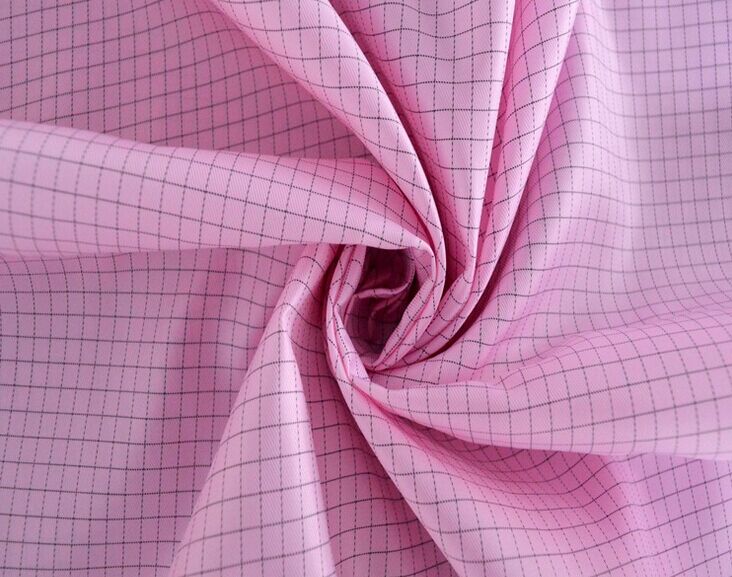
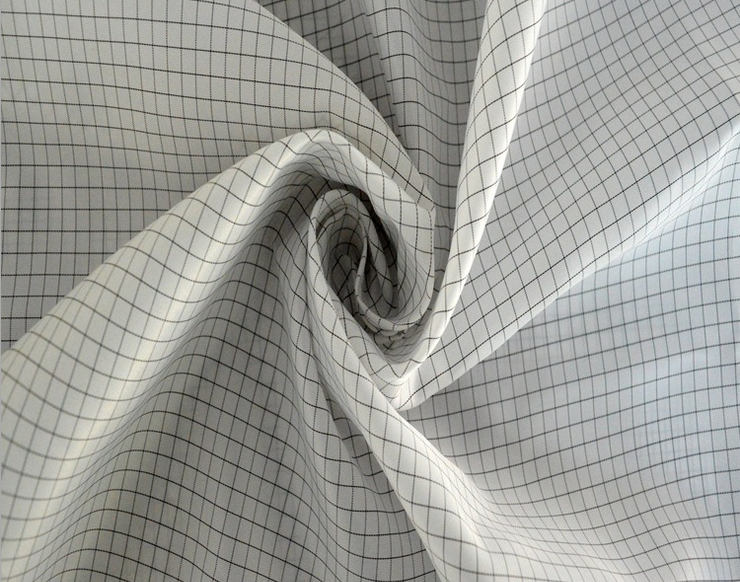
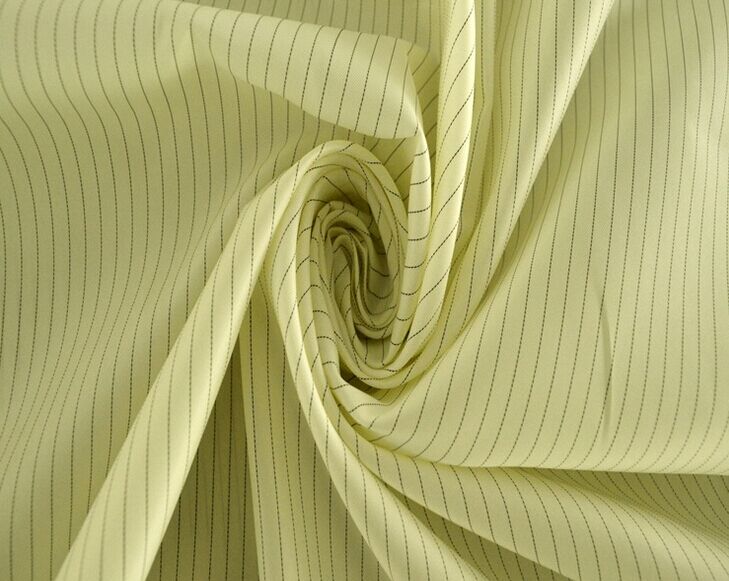
This fabric uses carbon conductive yarn (1%) integrated into the structure with a 0.5cm conductive spacing.
That conductive pathway helps charges dissipate more effectively than standard synthetic fabrics (which can accumulate charge through friction and movement).
2) Resistance range designed for static control apparel
The page lists 10⁶–10⁸ Ω as the resistance target.
In practice, ESD requirements differ by industry and standard (electronics EPA vs. ATEX-style environments). Your ESD manager or compliance team should match the garment fabric + design to your control plan and verification method.
3) Garments must be grounded to be effective
Even excellent ESD fabric is only one piece of the solution. IEC guidance on static control garments highlights that a key goal is selecting appropriate garments and that, to effectively control charges, the garment should be grounded (as part of an overall ESD control approach).
Typical Applications for Premium B2B Programs
This ESD twill taffeta is described as widely used in laboratory garments to help protect from static-related harm.
In real production sourcing, common apparel applications include:
-
ESD lab coats / ESD smocks (electronics assembly, inspection lines)
-
Cleanroom uniforms (where static attracts particles)
-
ESD coveralls & work jackets (precision instruments, controlled manufacturing zones)
-
ESD liners / internal panels in PPE garments (when static control is specified)
If you tell us your end use (electronics EPA, cleanroom class target, or general lab use), we can recommend the most suitable fabric structure and verify which test method your customer requires.
Why B2B Brand Buyers Choose This Fabric
Lightweight but durable for daily uniforms (108 gsm)
At 108 gsm, the fabric is comfortable for long shifts and reduces garment weight—useful for mass uniform programs and cleanroom workwear where comfort affects compliance and productivity.
Production-friendly weave: 2/3 twill
A 2/3 twill generally provides a balanced handfeel and good drape for coats, smocks, and coveralls, supporting stable cutting and sewing for OEM factories.
Clean, spec-driven sourcing
When buyers compare suppliers, they usually want “spec clarity”: composition, conductive spacing, resistance range, weight, width, and MOQ. This page provides those key procurement fields directly.
Standards & Testing
Different markets and industries specify ESD clothing using different standards or internal specs.
-
EN 1149 is a key reference series for electrostatic properties of protective clothing, describing requirements and test methods for electrostatic dissipative clothing to avoid incendiary discharges—while also noting limitations (e.g., not for mains voltage protection, and may not be sufficient for oxygen-enriched flammable atmospheres).
-
IEC 61340-4-9 provides test methods for evaluating the electrical resistance of garments used for electrostatic discharge control (sleeve-to-sleeve and point-to-point methods).
-
Many ESD programs also require documented training, qualification, and compliance verification as part of an overall ESD control program plan (per EN 61340-5-1 program guidance).
Important for buyers: Fabric performance ≠ garment certification. Final compliance depends on the finished garment design (seams, cuffs, closures), correct grounding, and your site’s ESD control plan.
Customization Options
For premium brand programs, buyers often request:
-
Color options (common uniform colors)
-
Conductive pattern options (grid/stripe spacing, subject to your spec)
-
Width / packing requirements (roll length, labeling, carton marks)
-
Bulk consistency controls (shade band / lot tracking for repeat orders)
Share your end-customer spec sheet or tender requirements and we’ll align the sampling and production plan.
Ordering Information
-
MOQ: 1000 meters
-
Payment: T/T, L/C, Western Union
-
Packing: roll packing (or per buyer requirement—tell us your cutting-room preference)
Call to Action (RFQ / Sample / Technical Sheet)
If you’re sourcing ESD fabric for cleanroom or laboratory garments, send your target use, color, quantity, and required test standard (EN 1149 / IEC 61340 or your internal method). We’ll reply with a detailed offer, lead time, and sampling options.
Contact Us for a Detailed Offer:
Company: Lean Textile Co., Ltd.
Website: https://www.technical-fabrics.com/
Email: [email protected]
WhatsApp / WeChat: 008615051486055
FAQ
1) What is the standard composition of this ESD fabric?
It is 99% polyester + 1% carbon, designed to provide conductive pathways for static control.
2) What does “0.5cm conductive spacing” mean?
It refers to the spacing of the conductive yarn network (grid/stripe) in the fabric. This product lists 0.5cm spacing.
3) What is the resistance range?
The product page lists 10⁶–10⁸ Ω.
Your target range may vary depending on your ESD program and verification method.
4) Can ESD fabric alone prevent ESD issues?
No—ESD garments are typically part of a broader ESD control program (grounding, training, compliance verification). Guidance for ESD programs emphasizes documentation and grounding practices.
5) Which industries commonly use ESD garments?
This fabric is described as widely used for laboratory garments to reduce static-related harm.
Many ESD garment programs also exist in electronics assembly and cleanroom operations (specs vary by customer).
6) What are the standard weight and width?
108 gsm and 148 cm width.
7) What is the weave/style?
It is a 2/3 twill construction.
8) What is the MOQ and payment method?
MOQ is 1000 meters. Payment options listed: T/T, L/C, Western Union.
9) Do you provide test support for buyer audits?
We can align sampling and documentation to your required route. For garment electrical resistance testing, IEC 61340-4-9 outlines garment resistance measurement methods.
Anti-static Fabric
SEND INQUIRY
Related Products

Copyright © 2026 Lean Textile Co., Limited All rights reserved