


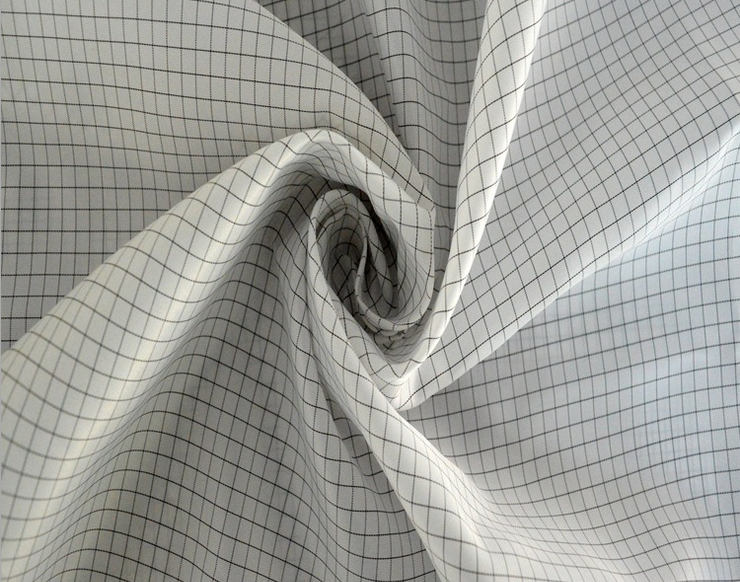
Anti-static plain grid taffeta fabric
Our Anti-Static Plain Grid Taffeta (ESD Fabric, Item F810) is a lightweight, production-friendly fabric designed for B2B garment programs that require static control in workplaces such as laboratories, power facilities, and oil/chemical environments. Built with 98% polyester and 2% carbon conductive yarn, it features a 0.5 cm conductive grid and a listed resistance range of 10⁶–10⁸ Ω, making it an efficient option for garment linings, lab coats, ESD smocks, and protective workwear layers where consistent sourcing and repeat orders matter.
Inquiry- Description
Anti-Static Plain Grid Taffeta Fabric (ESD Fabric) – F810
Static electricity is more than an annoyance in professional manufacturing and laboratory environments. It can lead to handling risks, process instability, and (in certain scenarios) higher operational risk. That’s why premium B2B buyers don’t just purchase “anti-static fabric”—they purchase materials that fit into a broader ESD control approach, with defined specifications, consistent production, and verification planning.
This product page rewrite is built for serious procurement teams: clear specs, buyer-safe claims, and conversion-focused structure—so brand customers can quickly decide whether F810 matches their workwear program.
Key Specifications
Below are the core fields B2B buyers typically need for RFQs and tech packs:
-
Item name: Anti-static plain grid taffeta fabric, ESD Fabric
-
Item No.: F810
-
Material: 98% polyester / 2% carbon
-
Yarn Count: 75D × 75D
-
Weight: 90 gsm
-
Density: 160 × 89
-
Width: 148 cm
-
Style: Plain
-
Conductive space: 0.5 cm (grid)
-
Resistance: 10⁶–10⁸ (Ω as listed)
-
MOQ: 1000 meters
-
Payment: TT, L/C, Western Union
What Makes F810 an “ESD / Anti-Static” Fabric?
1) Carbon conductive yarn integrated into the structure
F810 uses carbon conductive content (2%) to create a controlled pathway for dissipating charges compared with ordinary synthetic linings that can build static easily.
2) 0.5 cm conductive grid for uniform performance
The 0.5 cm grid is one of the most procurement-friendly features on this fabric. It’s easy to document, easy to verify visually, and helps garment factories maintain consistency across cutting panels and garment lots.
3) “Dissipative-range” resistance positioning (10⁶–10⁸ Ω)
The page lists 10⁶–10⁸ Ω. That fits inside a commonly referenced “dissipative” window in ESD control materials (many ESD references describe dissipative as >10⁶ and <10⁹ ohms, depending on test method and application).
Important for buyers: resistance values can vary with humidity, laundering, garment construction, and the test method used. For audit-grade programs, you should always align fabric and garment testing to your required standard and internal acceptance criteria.
Why Premium B2B Buyers Choose This Plain Grid Taffeta
Lightweight comfort for better on-site compliance (90 gsm)
At 90 gsm, F810 is well-suited as a lining fabric and for lightweight garments where comfort matters. Comfortable uniforms are worn more consistently and correctly—an overlooked factor in real ESD control.
Stable, scalable construction for bulk uniform programs
With 75D×75D yarn, plain weave, and a clear spec sheet, the fabric supports efficient mass production for uniform suppliers and OEM garment factories.
Industry-relevant usage positioning
The page positions this fabric as widely used for garment lining in laboratory, power, and oil/chemical industries—the exact scenarios where B2B buyers often request ESD or anti-static features in workwear.
Typical Applications
Garment lining for ESD workwear
F810 is a strong choice for:
-
ESD jackets and coveralls (lining layer)
-
Workwear liners for industrial uniforms
-
Protective apparel layers where static control is specified
Laboratory garments and ESD smocks
Where lightness and clean appearance are priorities, F810 can be used in:
-
lab coats and inspection coats (lining or light outer layer depending on design)
-
ESD smocks for controlled work zones
Power / oil / chemical workwear systems
For industrial environments that request anti-static features, this fabric can serve as a reliable program material—especially where purchasing teams want consistent supply and stable repeat ordering.
Testing & Standards Notes
Fabric is one part of the ESD system
Many organizations manage ESD risk through a documented ESD control program, not fabric alone. Procurement teams often combine ESD garments with grounded flooring, wrist straps (where applicable), procedures, and verification.
Garment verification matters
If your customers require garment-level verification, IEC provides test methods for measuring the electrical resistance of garments used for static control applications (garment resistive characterization).
ATEX-style environments may require additional standards
If your garments are intended for areas with explosive atmospheres, buyers may reference the EN 1149 family (protective clothing—electrostatic properties) and require a “total earthed system” approach. Always confirm the exact market requirement and compliance route before quoting.
OEM / Custom Options for Brand Programs
To help premium B2B buyers standardize materials across product lines, typical options include:
-
Color customization (uniform colors, brand palette alignment)
-
Width / roll length / packing tailored to the cutting room
-
Grid direction and layout confirmation (for consistent garment appearance)
-
Lot consistency controls (shade band, lot tracking for repeat seasons)
-
Test alignment support (fabric swatch + garment prototype testing plan)
Send your tech pack or end-customer spec, and we’ll recommend the most efficient sampling route.
Ordering Information
-
MOQ: 1000 meters
-
Payment terms: TT, L/C, Western Union
For best results on B2B programs, we recommend:
-
confirm shade + handfeel with lab dips / samples
-
prototype a garment and run your required tests
-
lock bulk with lot control requirements for repeat orders
Call to Action (RFQ / Sample / Technical Sheet)
If you’re sourcing anti-static plain grid taffeta for ESD garment lining or laboratory workwear, share your application, target resistance requirement, color, and order quantity. We’ll respond with a detailed offer, sampling options, and production recommendations.
Contact Us for a Detailed Offer:
Company: Lean Textile Co., Ltd.
Website: https://www.technical-fabrics.com/
Email: [email protected]
WhatsApp / WeChat: 008615051486055
Fast RFQ checklist (recommended):
-
end use (lining / lab coat / smock / coverall)
-
target market & required standard (if any)
-
color and annual forecast
-
testing method required (fabric vs garment)
-
delivery destination and packing preferences
FAQ
Q1: What is the composition of F810?
98% polyester / 2% carbon.
Q2: What does “0.5 cm conductive space” mean?
It refers to the spacing of the conductive grid in the fabric—listed as 0.5 cm.
Q3: What resistance range is listed?
The product page lists 10⁶–10⁸ (Ω as shown).
Q4: Is this fabric enough to guarantee ESD compliance by itself?
Usually not. ESD control is typically managed as a system (garments + grounding + procedures + verification).
Q5: What are the standard weight and width?
90 gsm and 148 cm width.
Q6: What is the yarn count and density?
75D×75D yarn; density 160×89.
Q7: What is the minimum order quantity (MOQ)?
1000 meters.
Q8: What is it commonly used for?
The page states it is widely used as garment lining in laboratory, power, and oil/chemical industries.
Q9: Can you support garment-level testing requirements?
If needed, we can align your sampling plan so the finished garment can be evaluated using recognized garment resistance characterization methods (e.g., IEC garment test methods).
Anti-static Fabric
SEND INQUIRY
Related Products

Copyright © 2026 Lean Textile Co., Limited All rights reserved