


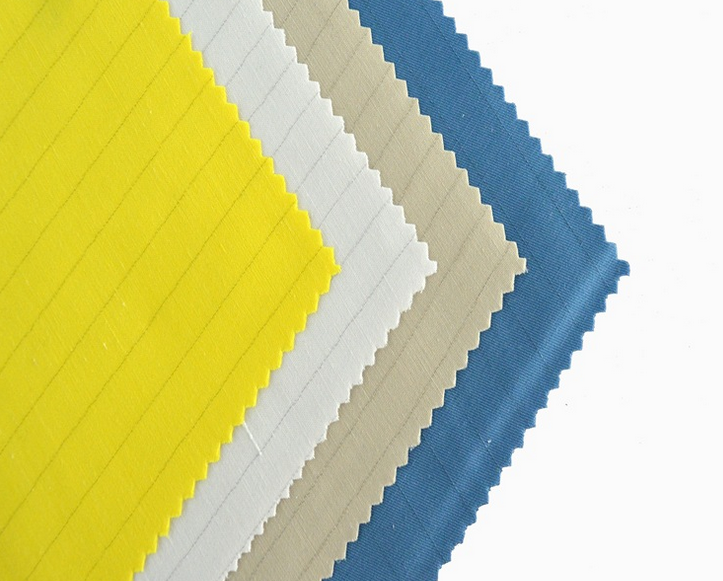
tissu mat bande anti-statique, ESD Tissu
Ce Anti-Static Stripe Matte Twill Fabric (ESD Tissu, Item F500) is a B2B-ready workwear textile engineered to reduce static build-up in professional environments such as laboratoires, power industry sites, and oil/chemical facilities. It uses a comfortable polyester/cotton blend (92% polyester, 7% coton) reinforced with 1% fil conducteur de carbone dans 1.2cm conductive stripe spacing, delivering a listed résistance de surface de 10⁶–10⁸ Ω. With a practical 150 GSM weight and 148 cm largeur, it’s ideal for clean, durable uniforms like jackets, combinaisons, blouses de laboratoire, and shop-floor workwear where ESD control is part of the purchasing checklist.
Enquête- Description
Anti-Static Stripe Matte Twill Fabric, ESD Tissu (F500)
Premium B2B buyers don’t purchase ESD fabric like a basic uniform cloth. They purchase it to reduce risk—risk of product damage in electronics-adjacent workflows, risk of nuisance static that lowers productivity, et (in certain environments) risk of electrostatic discharge becoming an ignition source.
That’s why good ESD workwear programs are built around three pillars:
-
A fabric with a conductive pathway (carbon yarn grid/stripe)
-
A garment design that supports consistent performance (proper patterning, fermetures, menottes, and wearing practices)
-
A site ESD control program (mise à la terre, procédures, et vérification)
This product (F500) focuses on pillar #1—providing a clear, spec-driven ESD stripe fabric that garment factories and brands can mass-produce reliably, while keeping the handfeel and wear comfort suitable for long shifts thanks to the polyester/cotton blend and twill construction.
Core Specifications
-
Nom de l'article: tissu mat bande anti-statique, ESD Tissu
-
Numéro d'article.: F500
-
Matériel: 92% polyester / 7% coton / 1% carbone
-
nombre de fils: 150D * 32S
-
Poids: 150 GSM
-
Densité: 130*70
-
Largeur: 148 cm
-
Style / tisser: Sergé
-
espace Conductive: 1.2 cm
-
La résistance: 10⁶–10⁸ Ω
-
MOQ: 1000 mètres
-
Typical industries mentioned: laboratoire, Puissance, oil/chemical workwear
Why This Fabric Converts with High-Quality B2B Buyers
1) Stripe conductive design (1.2espacement en cm) for repeatable ESD performance
Le 1.2espacement conducteur en cm is a strong “procurement-friendly” feature because it’s easy to document in spec sheets, compare across suppliers, and control in production.
Brands typically choose stripe/grid patterns based on garment style, confort, coût, and required verification method.
2) Positionnement de la résistance « plage dissipative » (10⁶–10⁸ Ω)
La page répertorie 10⁶–10⁸ Ω resistance.
Many ESD references describe ~10⁶ to 10⁹ ohms as a common “dissipative” window (décharge contrôlée plutôt qu'une étincelle soudaine).
That makes this fabric a practical fit for ESD workwear programs where buyers want controlled charge dissipation.
3) Polyester/cotton blend for comfort + durability in daily uniforms
100% synthetic ESD fabrics can feel hot or clammy in some workplaces. This fabric’s 7% coton improves comfort and wearability while the polyester backbone provides strength, stabilité dimensionnelle, and easier care.
For uniform programs, comfort isn’t a “nice-to-have”—it directly impacts compliance (whether workers actually wear the garments correctly).
4) Matte twill appearance for professional uniforms
A matte twill surface is often preferred for industrial uniforms because it looks cleaner, reduces shine, and maintains a “workwear” aesthetic. The twill structure also typically offers good drape and abrasion tolerance for daily use.
5) Spec clarity for OEM/ODM workflow
B2B brands and garment factories need a clean data set: composition, poids, largeur, conductive spacing, resistance, MOQ. This page includes exactly those fields, which reduces RFQ back-and-forth and speeds sampling decisions.
Applications recommandées
ESD workwear for industrial operations
-
ESD jackets, pants, combinaisons
-
Workshop uniforms for precision processes
-
Maintenance uniforms where static is a known issue
Lab & clean operating environments
-
Lab coats, inspection coats
-
Technical uniforms for controlled manufacturing
Pouvoir, huile & chemical industry workwear
The product page explicitly highlights laboratory, Puissance, and oil/chemical workwear use.
(If your environment includes explosive atmospheres/ATEX-type risks, your compliance team should specify the exact garment standard and system requirements.)
Normes & Notes de conformité
ESD control is a system—not just fabric
IEC 61340-5-1 is widely referenced for Programme de contrôle ESD exigences (how organizations design, implement, and maintain an ESD control program).
Even the best fabric performs best when used with proper grounding, procédures, et vérification.
DANS 1149 family is commonly referenced for electrostatic protective clothing
DANS 1149 standards are commonly used in Europe for protective clothing electrostatic properties, intended to prevent incendiary discharges in certain conditions.
Important: final compliance depends on the finished garment, le design, et le total earthed system used in the workplace—not only the fabric.
Buyer Checklist: What to Send in Your RFQ
To attract high-quality B2B buyers (and close them faster), invite them to provide:
-
End use garment type (lab coat / combinaison / veste / pants)
-
Target market (EU/UK/US/others) + required standards (le cas échéant)
-
Couleur & stripe direction preference (warp stripe vs weft stripe, if specified)
-
Order quantity & lieu de livraison
-
Required test method (surface resistance vs point-to-point garment testing)
This positions your offer like a professional supplier—exactly what premium buyers want.
Appel à l'action (Demande de prix / Échantillon / Fiche technique)
Si vous recherchez ESD stripe matte twill fabric for uniforms or protective workwear programs, send your application, couleur, quantité commandée, and required resistance/testing method. We’ll respond with a offre détaillée, délai de mise en œuvre, et options d'échantillonnage.
Contactez-nous pour une offre détaillée:
Entreprise: Lean Textile Co., Ltée.
Site Internet: https://www.technical-fabrics.com/
Email: [email protected]
WhatsApp / WeChat: 008615051486055
FAQ
T1: Quelle est la composition standard de ce tissu ESD?
C'est 92% polyester / 7% coton / 1% carbone, using carbon conductive yarn for static dissipation.
T2: What does “1.2cm conductive space” mean?
It refers to the spacing of the conductive stripe pattern in the fabric. Ce produit répertorie 1.2cm conductive space.
T3: Quelle est la plage de résistance?
La page produit répertorie 10⁶–10⁸ Ω.
Many ESD references describe ~10⁶–10⁹ ohms as a typical dissipative range, but your required range depends on your site program and verification method.
T4: Is the fabric alone enough to guarantee ESD safety?
Non. ESD protection is typically managed through an Programme de contrôle ESD (mise à la terre, procédures, vérification) in addition to ESD garments.
Q5: Quels sont le poids et la largeur standard?
150 GSM weight and 148 cm largeur.
Q6: What weave is it and why does it matter?
This fabric is sergé, which is commonly used for workwear due to good drape and durability in daily use.
Q7: What is MOQ and payment?
MOQ est 1000 mètres. Options de paiement répertoriées: TT, L / C, Western union.
Q8: Which industries is it designed for?
The page mentions use in laboratoire, power industry, and oil/chemical industry workwear.
Tissu anti-statique
ENVOYER UNE DEMANDE
Produits connexes

Copyright © 2026 Lean Textile Co., Limited Tous droits réservés