


310T Anti-static Twill Fabric, ESD Fabric for garment at laboratory
310T Anti-Static Twill Fabric (Item No. F630) is a lightweight, production-ready ESD fabric engineered for B2B uniform and protective-garment programs—especially laboratory garments—where controlling static build-up is part of the procurement requirement. It is made with 99% polyester + 1% carbon conductive yarn, uses a 2/3 twill structure, and features a 0.5cm conductive grid with a listed resistance range of 10⁶–10⁸ Ω. Standard specs include 75D×75D yarn, 108 gsm, and 148 cm width, supporting consistent cutting/sewing and repeat bulk supply.
Inquiry- Description
310T Anti-Static Twill Fabric (ESD Fabric) – F630
If you supply lab coats, ESD smocks, inspection jackets, or controlled-area workwear, you already know the pain points buyers complain about:
-
“Our uniforms still generate static in dry seasons.”
-
“Operators don’t like the fabric—too hot, too noisy, too stiff—so compliance drops.”
-
“Audit teams ask for ESD documentation and a repeatable testing method.”
-
“Bulk lots vary, and the garment factory can’t hold stable performance.”
High-quality B2B buyers don’t buy “anti-static fabric” as a buzzword. They buy materials that fit into a clear ESD control program—with documented requirements and objective evidence. IEC 61340-5-1 is widely used to define ESD control program requirements, which is why serious buyers want fabric specs that can be verified and repeated.
F630 is designed for that type of sourcing: clear specs, conductive structure, and a production-friendly 310T-class construction that garment factories can run at scale.
Key Specifications
These are the exact purchasing fields listed on the referenced page:
| Item | Specification |
|---|---|
| Item name | ESD / Anti-static Fabric 2/3 Twill |
| Item No. | F630 |
| Material | 99% polyester / 1% carbon |
| Yarn count | 75D × 75D |
| Weight | 108 gsm |
| Density | 188 × 120 |
| Width | 148 cm |
| Weave / style | 2/3 Twill |
| Conductive space | 0.5 cm (grid) |
| Resistance | 10⁶–10⁸ (Ω as shown) |
| MOQ | 1000 meters |
| Payment | TT, L/C, Western Union |
| Use note | “widely used in garment at laboratory …” |
What “310T” Means
In textile trade, “T” commonly refers to thread count (warp + weft per square inch). Higher T values generally indicate a tighter, denser weave—often used when buyers want smoother surface, better barrier feel, and stable construction.
For ESD garments and lab uniforms, this matters because a denser construction can support:
-
Cleaner appearance and professional uniform look
-
Stable cutting and sewing (less distortion)
-
Comfortable lightweight build at 108 gsm (important for shift wear)
(Your final garment performance also depends on design, seams, cuffs, closures, and how the uniform is worn inside the ESD program.)
Why This Fabric Works for Premium B2B Programs
1) Carbon conductive yarn network (99/1 with defined grid)
F630 uses 1% carbon conductive yarn integrated into the fabric structure, creating pathways for charge dissipation compared with ordinary synthetics that can accumulate static.
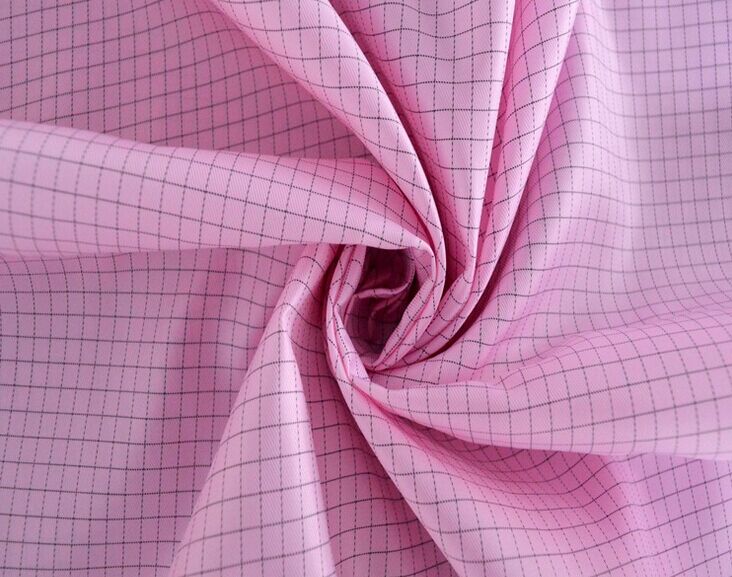
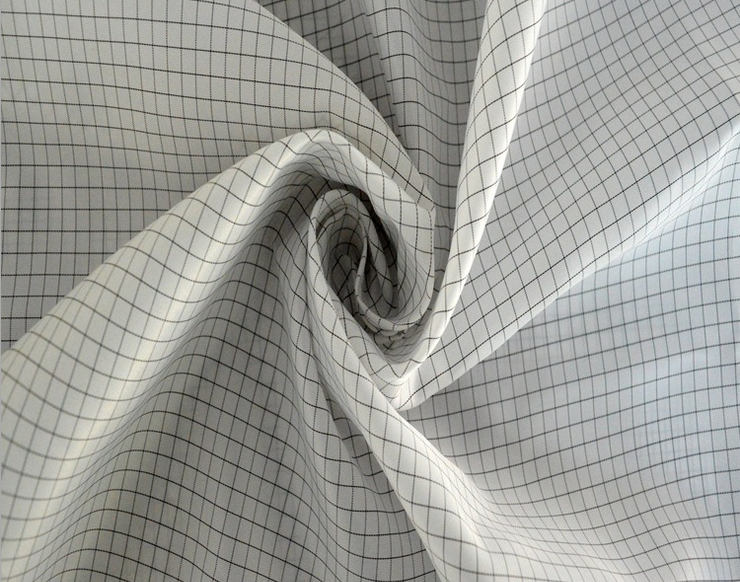
2) 0.5cm conductive grid = easy to specify, easy to QC
The 0.5cm conductive spacing is a “procurement-friendly” feature:
-
easy to write into tech packs
-
easy to check visually during incoming inspection
-
consistent for repeat orders and multi-factory sourcing
3) Resistance range positioned for dissipative control
The page lists 10⁶–10⁸ Ω.
In real programs, resistance values can shift with humidity, laundering, garment construction, and the test method. That’s why strong buyers align fabric selection with a recognized garment testing route (see the next section).
4) 2/3 twill performance for uniform comfort + durability
Twill constructions are widely used in workwear because they offer a balanced combination of drape, durability, and a professional surface. This product is specified as 2/3 twill.
5) Lightweight 108 gsm supports “wear compliance”
ESD garments are only effective when people actually wear them correctly. At 108 gsm, F630 helps brands build lighter uniforms that are easier to wear for full shifts, especially in warm indoor environments.
Typical Applications
The product page states this fabric is widely used in laboratory garments.
In practical B2B development, common applications include:
-
ESD lab coats / lab jackets
-
ESD smocks / inspection coats
-
Light coveralls for controlled work zones
-
Uniform panels or layers in ESD-managed operations
If you share your end use (lab uniforms vs electronics assembly vs clean manufacturing), the sourcing spec can be matched to comfort requirements, durability needs, and verification methods.
Testing & Compliance Guidance
ESD control is a program, not just a fabric claim
IEC 61340-5-1 defines requirements for an ESD control program—a key concept for serious buyers. If your customer follows IEC 61340-5-1 (or similar standards), they typically want controlled materials plus documented procedures and objective evidence.
Garment-level testing matters (not only fabric swatches)
When buyers request audit-grade results, they often ask for garment resistance tests. IEC 61340-4-9 describes garment resistance test methods, including point-to-point and sleeve-to-sleeve measurements, and notes the test can include resistance across seams and cuffs where applicable.
Practical takeaway for B2B buyers:
If your end customer requires verification, plan sampling like this:
-
confirm fabric lot + conductive pattern
-
build a prototype garment (with your real cuffs/closures)
-
test the finished garment using your required method (IEC garment testing route)
If your market is ATEX/explosive-risk, confirm EN 1149 route
Some oil/chemical or explosive-risk environments reference EN 1149-5 for protective clothing electrostatic performance as part of a total earthed system. If your RFQ is for ATEX-type risks, tell us early so we match the correct compliance path.
OEM / Customization Options
Premium buyers typically don’t want “one standard only.” They want a program material they can lock into a tech pack. Common customization requests include:
-
Color matching (uniform systems, brand colors)
-
Handfeel tuning (softer vs crisper) depending on garment type
-
Packing and labeling (roll length, barcode labels, lot tracking for repeat orders)
-
Performance verification plan (fabric checks + garment prototype testing route)
Share your tech pack or buyer spec sheet, and we’ll recommend the most efficient sampling path.
Ordering Information
-
MOQ: 1000 meters
-
Payment: TT, L/C, Western Union
For brand programs, best practice is:
-
approve lab dips / sample yardage
-
build and test 1–2 garment prototypes
-
confirm bulk with lot controls for repeatability
Call to Action (RFQ / Sample / Technical Sheet)
If you’re sourcing 310T anti-static twill fabric (F630) for laboratory garments or ESD-managed uniforms, send your application, target resistance requirement, color, and order quantity. We’ll respond with a detailed offer, sampling options, and a testing-aligned recommendation.
Contact Us for a Detailed Offer:
Company: Lean Textile Co., Ltd.
Website: https://www.technical-fabrics.com/
Email: [email protected]
WhatsApp / WeChat: 008615051486055
Fast RFQ checklist (recommended):
-
garment type (lab coat / smock / coverall)
-
target market & required standard (IEC program / EN route if needed)
-
color + annual forecast
-
testing method required (fabric vs garment testing)
-
delivery destination + packing preferences
FAQ
Q1: What is the standard composition of F630?
It is 99% polyester + 1% carbon.
Q2: What does “0.5cm conductive space” mean?
It refers to the spacing of the conductive grid in the fabric—listed as 0.5 cm.
Q3: What resistance range is listed for this ESD fabric?
The product page lists 10⁶–10⁸ (Ω as shown).
Q4: Is the fabric alone enough to guarantee ESD compliance?
Usually not. Many buyers follow an ESD program approach (e.g., IEC 61340-5-1), where garments are one element in a controlled system with documented requirements.
Q5: Do we need garment-level testing for customer audits?
Often yes. IEC 61340-4-9 describes garment resistance test methods (point-to-point and sleeve-to-sleeve) and can include resistance across seams/cuffs.
Q6: What are the standard weight and width?
108 gsm and 148 cm width.
Q7: What weave is this fabric and why does it matter?
It is 2/3 twill, commonly preferred for uniform-style garments because it balances drape, durability, and a professional appearance.
Q8: What does “310T” generally indicate?
In textile trade, “T” commonly refers to thread count; higher T often indicates a denser weave.
Q9: What is the MOQ and payment method?
MOQ is 1000 meters. Payment options listed: TT, L/C, Western Union.
Q10: Can this be used for oil/chemical environments that request EN 1149?
Potentially, but EN 1149-5 requirements apply to protective clothing for electrostatic risk environments as part of a total earthed system. Confirm your exact standard and compliance route before finalizing sourcing.
Anti-static Fabric
SEND INQUIRY
Related Products
Copyright © 2026 Lean Textile Co., Limited All rights reserved