


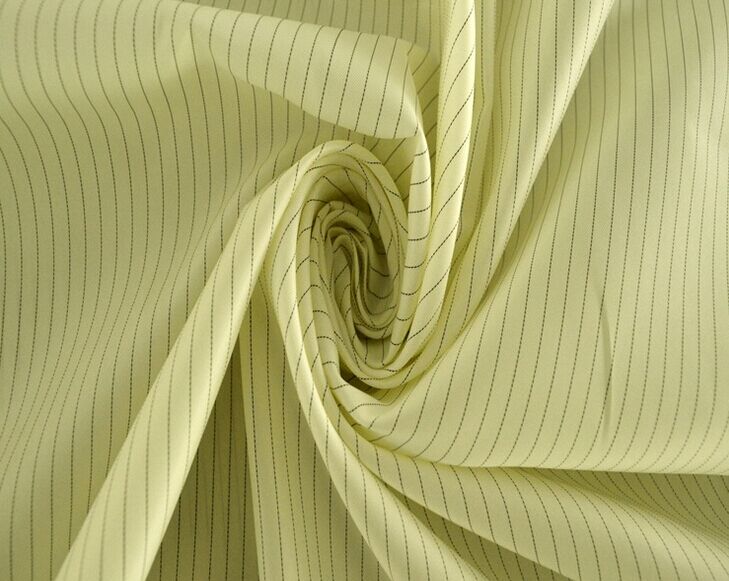
Antystatyczna gładka tkanina z tafty w paski, Tkanina ESD do laboratorium
Ten Anti-Static Plain Stripe Taffeta (Tkanina ESD, Nr artykułu. F610) jest lekki, production-friendly fabric engineered for laboratory and ESD-controlled garment programs. It features 99% polyester with 1% przędza przewodząca węgiel, arranged in 0.5cm conductive stripes, delivering a listed resistance range of 10⁶–10⁸ Ω. Z 75D×75D yarn, 90 gsm, I 148 cm szerokość, it’s designed for B2B buyers who need consistent bulk supply for lab coats, ESD smocks, light uniforms, and protective garments where static control is part of the purchase requirement.
Zapytanie- Opis
Anti-Static Plain Stripe Taffeta Fabric (Tkanina ESD) – F610
In ESD-sensitive environments, static isn’t just a comfort issue—it can become a ryzyko jakościowe (handling sensitive components), A ryzyko procesowe (unwanted attraction of particles), and in some industries a safety concern. Professional buyers don’t treat ESD clothing as a “basic uniform.” They treat it as a controlled input within a broader ESD program, Gdzie przybory, projekt ubioru, grunt, and verification all matter.
This product (F610) is built for that type of procurement: clear specs, skalowalne dostawy, and a structure that garment factories can cut and sew efficiently. The plain stripe conductive design i 10⁶–10⁸ Ω resistance positioning make it easy for brands and OEMs to align fabric selection with internal ESD requirements and customer audits—without overcomplicating sourcing.
Kluczowe dane techniczne
-
Item Name: Antystatyczna gładka tkanina z tafty w paski, Tkanina ESD
-
Item No.: F610
-
Tworzywo: 99% poliester, 1% węgiel
-
Liczba przędzy: 75D × 75D
-
Waga: 90 gsm
-
Gęstość: 160 × 89
-
Szerokość: 148 cm
-
Styl: Zwykły
-
Conductive Space: 0.5 cm
-
Opór: 10⁶–10⁸ (Ω as listed)
-
MOQ: 1000 meters
-
Zapłata: TT, Akredytywa, Western Union
-
Typical Use Mentioned: odzież laboratoryjna
What Makes This Fabric “ESD / Anti-Static”?
1) Carbon conductive yarn integrated into the fabric
The fabric’s ESD performance is driven by przędza przewodząca węgiel (1% węgiel), which provides a conductive pathway so charges can dissipate more predictably compared with ordinary synthetic textiles.
2) Plain stripe conductive pattern (0.5cm spacing)
The conductive element is arranged in plain stripes, z 0.5cm odstępu przewodzącego.
Dla kupujących B2B, this is valuable because it’s:
-
easy to document in a tech pack/spec sheet,
-
straightforward for QC checks,
-
consistent for repeat programs.
3) Resistance range designed for controlled dissipation
Listy produktów 10⁶–10⁸ Ω.
As a reference point, ESD industry resources commonly describe “dissipative” ranges in the neighborhood of >10⁶ and <10⁹ ohms (exact requirements vary by standard and application).
That makes this fabric a practical choice for many lab and ESD-workwear requirements—provided your program confirms the exact test method and acceptance window.
Why Premium B2B Buyers Choose F610
Lightweight 90 gsm for comfortable, compliance-friendly wear
Na 90 gsm, the fabric supports lightweight garments that workers are more likely to wear correctly for full shifts—an overlooked factor that directly affects ESD compliance in real operations.
Czysty, spec-driven sourcing for brands and uniform programs
Procurement teams want clear fields: kompozycja, odstęp przewodzący, resistance, waga, szerokość, przędza. This page provides those “decision fields” directly, which shortens RFQ cycles and makes it easier to compare suppliers on an apples-to-apples basis.
Stable base structure for OEM garment production
Z 75D×75D yarn and a lightweight woven build, the fabric is suitable for large-scale cutting and sewing of lab garments and ESD smocks, where efficiency and consistent handling matter.
Typowe zastosowania
The product is described as widely used for odzież laboratoryjna.
In real B2B development, this category often includes:
-
Fartuchy laboratoryjne ESD / fartuchy for inspection and controlled areas
-
Light ESD jackets and over-garments
-
Workshop uniforms in ESD-managed zones
-
Protective apparel layers where static control is a procurement requirement
If you share your end-use scenario (laboratory apparel vs electronics assembly vs cleanroom-related), the fabric selection can be matched to your comfort needs, durability expectations, and verification route.
Standardy & Testing Guidance
ESD fabric is only one part of ESD control
IEC guidance emphasizes ESD control as a program, including grounding and verification—not fabric alone.
This is important for brands: avoid over-claiming “ESD safe” purely from fabric. A correct approach is:
-
specify fabric performance (np., zakres rezystancji, conductive pattern),
-
test finished garments according to required method,
-
apply garments within the facility’s ESD program.
Garment testing matters (not just fabric swatches)
IEC 61340-4-9 describes test methods for measuring opór elektryczny odzieży used for static control applications (np., metodą rękaw do rękawa i punkt do punktu).
If your customer audit requires garment-level results, plan sampling so your garment factory can test the finished coat/smock, łącznie ze szwami, mankiety, and closures.
If your environment is ATEX-like (explosive atmospheres)
If you’re supplying oil/chemical or explosive-risk areas, you may encounter EN 1149 requirements for protective clothing electrostatic properties. This is a different procurement route than typical electronics EPAs—so please specify your market and standard early.
OEM / Opcje niestandardowe
For premium B2B buyers, customization is often what closes the deal. Common requests include:
-
Opcje kolorów (uniform systems, brand palettes)
-
Stripe layout direction (warp/weft preferences in tech packs)
-
Szerokość / długość rolki / uszczelka aligned to cutting-room efficiency
-
Lot consistency controls (pasmo cienia, śledzenie partii w przypadku powtarzających się zamówień)
-
Test alignment to your ESD program (fabric tests + garment tests)
Ordering & Warunki handlowe
-
MOQ: 1000 meters
-
Zapłata: TT, Akredytywa, Western Union
For brand programs, the best practice is: approve a small sampling run first (for garment build + testowanie), then lock bulk with lot controls.
Wezwanie do działania (Zapytanie ofertowe / Próbka / Karta techniczna)
Jeśli pozyskujesz ESD stripe taffeta fabric for laboratory garments or ESD-controlled apparel, send your application, kolor, ilość zamówienia, and required test standard/method. Odpowiemy za pomocą szczegółowa oferta, sampling options, and program recommendations.
To get the fastest quotation, include:
-
garment type (lab coat / smock / kurtka)
-
target resistance requirement + test method (fabric vs garment)
-
kolor + annual volume
-
delivery destination and required packaging
Często zadawane pytania
Pytanie 1: What is the standard composition of F610?
99% poliester + 1% węgiel conductive yarn.
Pytanie 2: What does “0.5cm conductive space” mean?
It refers to the spacing of the conductive stripe pattern—listed as 0.5 cm.
Pytanie 3: What resistance range is listed for this ESD fabric?
Listy produktów 10⁶–10⁸ (Ω as shown).
Pytanie 4: Is ESD fabric alone enough to guarantee ESD compliance?
Usually not. ESD control is typically managed through an ESD program (procedures, grunt, verification) in addition to garments.
Pytanie 5: Do we need garment-level testing?
Often yes—especially for audits. IEC 61340-4-9 describes garment resistance characterization methods used for static control garments.
Pytanie 6: Jaka jest standardowa waga i szerokość?
90 gsm I 148 cm szerokość.
Pytanie 7: What is the standard yarn count and density?
75D×75D, gęstość 160×89.
Pytanie 8: What is the MOQ and payment term?
MOQ jest 1000 meters; payment options listed include TT, Akredytywa, Western Union.
Pytanie 9: Can you support bulk uniform programs with repeat orders?
Yes—share your annual forecast, color requirements, and testing route. We’ll propose a sampling + lot control plan suitable for repeat seasons.
Tkanina antystatyczna
WYŚLIJ ZAPYTANIE
Powiązane produkty

Prawa autorskie © 2026 Lean Textile Co., Ograniczone Wszelkie prawa zastrzeżone