


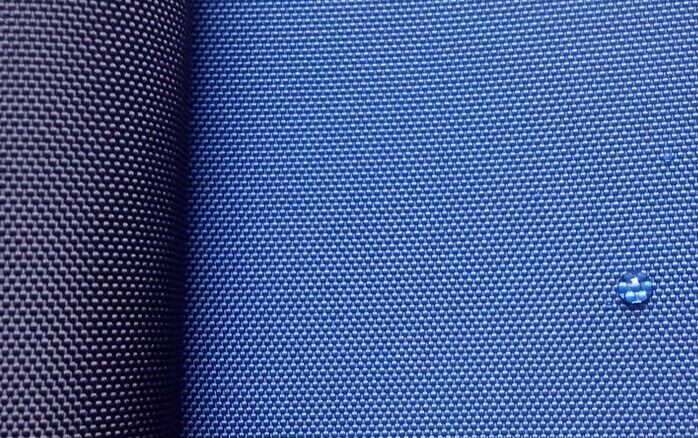
420D oxford fabric pu coated
When brands source coated Oxford fabrics, the “spec sheet” is only half the story. The real challenge is getting a fabric that holds up in production and in end use: clean cutting, predictable seam performance, stable coating quality, and waterproof protection that doesn’t fail under pressure points, folds, or repeated handling.
This 420D Nylon Oxford PU-coated fabric is built as a practical platform for bulk programs. It combines a stable 1/1 Oxford weave, a controlled PU barrier coating, and a face-side DWR treatment that improves water beading and reduces wet-out—helping finished products look better in rain and dry faster after exposure.
If you are developing a long-term SKU for rainwear, outdoor covers, bags, or tent accessories, this specification is procurement-friendly: clear mechanical data, clear waterproof target, and a finish system aligned with mainstream outdoor product expectations.
Inquiry- Description
Key Specifications
These are the exact purchasing fields listed on the referenced product page:
| Item | Specification |
|---|---|
| Base fabric | Nylon 420D, PU coated |
| Weave | L 1/1 |
| Total weight | 190 gsm |
| Threads (warp/weft) per cm | 19 / 14 |
| Base cloth weight | 150 gsm |
| Width | 150 cm |
| Tensile strength | 1400 / 1000 N (5 cm) |
| Tear resistance | 80 / 70 N (5 cm) |
| Water column | > 5000 mm |
| Special treatment | DWR > 90% |
| Applications | Rainwear, covers, bags, tent |
What “420D Oxford” Means (Why Buyers Specify This Denier)
In outdoor and industrial textiles, denier is often chosen based on the product’s failure points.
420D is commonly selected when buyers want:
-
Stronger fabric body than light rainwear fabrics, so it resists tearing and abrasion during handling
-
Better packability and flexibility than heavy 600D/900D/1000D, so it still folds and sews efficiently
-
A stable construction for accessories and cover products that get dragged, strapped, and stored repeatedly
Combined with a 1/1 Oxford weave, this fabric offers reliable structure for converting—especially important for B2B programs where multiple factories may cut and sew the same fabric across different SKUs.
PU Coating + DWR: Why This System Works in Real Products
1) PU coating = the waterproof barrier foundation
The PU coating is the primary barrier layer that drives the listed water column > 5000 mm.
In general, “waterproof rating” refers to how much water pressure a fabric can resist before leaking—commonly measured in millimeters via a hydrostatic head (water column) test.
Practical buyer note: Fabric waterproof rating is not the same as “the finished product will never leak.” Seams, stitch density, seam tape choice, and product design determine real-world waterproofness—especially for rainwear and tent items.
2) DWR > 90% = better beading, less wet-out, easier maintenance
DWR (Durable Water Repellent) is a finish applied to the face fabric to help water bead and roll off instead of saturating the surface (“wetting out”). In many rainwear systems, DWR improves comfort and performance by keeping the outer face from becoming waterlogged.
This product specifies DWR > 90%, which is helpful for rain exposure, splash, and general outdoor use where appearance and quick dry matter.
Why This Fabric Works for Premium B2B Programs
1) Procurement-friendly strength for stress points
For covers and bags, failures often happen at corners, strap anchors, and fold lines. This fabric provides clear mechanical strength values:
-
Tensile: 1400/1000 N (5 cm)
-
Tear: 80/70 N (5 cm)
That makes it easier for sourcing teams to write requirements into tech packs—and easier for incoming inspection teams to verify.
2) Balanced build for rainwear + covers
The listed 190 gsm total weight (with 150 gsm base cloth) is a practical balance: not overly heavy, but substantial enough for covers and structured applications.
If your program needs a softer garment handfeel or a firmer cover handfeel, coating type and back-side finish can be tuned during sampling.
3) Consistent width for efficient marker planning
A standard 150 cm width supports better cutting efficiency and consumption control for factories, especially when you scale into bulk production.
4) Waterproof rating aligned to many outdoor needs
A >5000 mm water column sits in a practical range for many rainwear and outdoor cover applications (when seams are managed correctly).
Typical Applications (Where Buyers Use This Spec)
The product page lists these target applications: rainwear, covers, bags, tent.
Here’s how B2B buyers typically map that into real SKUs:
Rainwear
-
Rain jackets, ponchos, over-trousers
-
Industrial rainwear where durability is prioritized
Tip: If you plan seam taping, confirm tape compatibility and bonding window during sampling.
Covers
-
Outdoor furniture covers, grill covers, equipment covers
-
Protective covers for transport/storage
Tip: Specify reinforcement patches at corners and strap points; this fabric’s tear/tensile profile supports those high-stress areas well.
Bags and accessories
-
Outdoor bags, tool bags, liners, duty accessories
-
Wipe-clean, weather-resistant soft goods
Tip: Confirm abrasion expectations based on your use case (ground contact vs body contact vs internal liners).
Tent components
-
Select tent panels, accessory components, storage bags
Tip: Validate based on seam sealing method and intended exposure duration.
Development Options
Serious B2B programs usually require “a controlled platform + customization.” Typical options include:
-
Color matching (Pantone or physical swatch)
-
PU coating variation (barrier level vs handfeel balance)
-
DWR tuning for your market (beading priority vs softer touch)
-
Printing / branding for covers and bag programs
-
Optional functional add-ons (project-dependent): anti-mildew, UV considerations, FR variants
If you already have a benchmark fabric from another supplier, send a sample. Matching becomes faster when your reference is physical.
Testing & Quality Guidance
To avoid returns and production waste, B2B buyers often validate these checkpoints before bulk:
-
Hydrostatic head / water column verification for the finished spec
-
Coating uniformity (pinholes, streaks, coating weight stability)
-
DWR beading after basic handling (to confirm face performance)
-
Cut & sew trial to confirm seam performance, needle choice, and stitch density
-
If applicable: seam tape bonding window (temperature/pressure/time)
Because waterproof performance is sensitive to seams, many brands treat fabric selection and seam strategy as one package—especially in rainwear.
Call to Action (RFQ / Sample / Technical Sheet)
If you’re sourcing 420D Nylon Oxford PU Coated fabric with >5000 mm waterproof rating and DWR > 90% for rainwear, covers, bags, or tent-related programs, send your requirements and we’ll respond with a detailed offer and the most suitable sampling direction.
Contact Us for a Detailed Offer:
Company: Lean Textile Co., Ltd.
Email: [email protected]
WhatsApp / WeChat: 008615051486055
FAQ
Q1: What is the base fabric and construction?
A: The product page specifies Nylon 420D with PU coating and L 1/1 weave.
Q2: What are the standard weight and width?
A: 190 gsm total weight and 150 cm width.
Q3: What waterproof level is specified?
A: Water column > 5000 mm.
Q4: What does “water column (mm)” represent?
A: It is a waterproof rating indicating how much water pressure a fabric can withstand before leaking, commonly measured by a hydrostatic head test.
Q5: What does DWR do, and why is it included?
A: DWR helps water bead on the face fabric and reduces wet-out; it’s widely used on rainwear systems to keep the outer surface from saturating.
Q6: What are the tensile and tear values?
A: Tensile 1400/1000 N (5 cm) and tear 80/70 N (5 cm).
Q7: Is this better for rainwear or for covers?
A: It’s listed for both. The best fit depends on your handfeel target and seam strategy. For rainwear, confirm seam taping and comfort; for covers, confirm folding frequency and abrasion zones.
Q8: Can you customize coating/handfeel for different products?
A: Typically yes—PU coating and surface finish can be tuned. Share your target use and performance priorities so the sample matches your production reality.
Q9: Can this be used for tent fabrics?
A: The product page lists “tent” as an application. Validate with your tent structure, seam sealing method, and target exposure conditions.
Q10: What information should I send for an accurate quotation?
A: End use (rainwear/covers/bags/tent parts), color requirement, target waterproof/DWR expectations, quantity per color, and delivery destination/window.
Coated Fabric, Oxford Fabric
SEND INQUIRY
Related Products


Copyright © 2026 Lean Textile Co., Limited All rights reserved